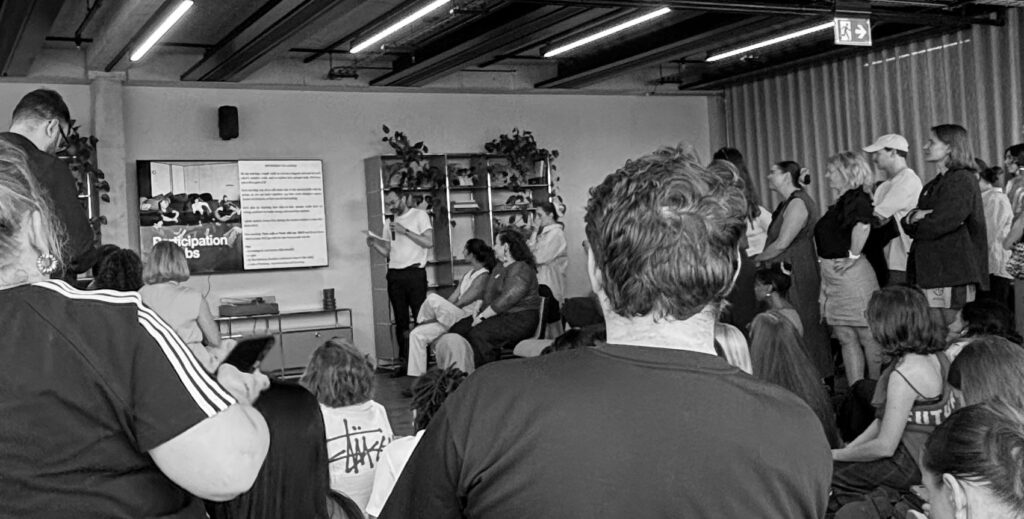
I spent two hours on Friday morning a couple of weeks ago listening to some really generous talks at an event called Future Friends x London – a global series of events focused on sharing signals of future cultural behaviour. Hosted by Amy Daroukakis and Rhiannon Jones, it was a quick-fire format of eight speakers, three signals, three minutes each. There was so much in there that it’s taken me time to sit with it and process it.
The vibe was very much about people working out how the current shifts in technology, trust, community and connection play out and how we, as humans, are responding to this moment. Some signals I’ve seen in our research from work with audiences, others offering different perspectives, felt particularly relevant to cultural institutions.
Signal 1: Pushing back against the algorithm.
Across all eight speakers, there was reference to being more personal, more local, more tangible, which is in part about people wanting things that are more relevant, but also smaller and unique.
However, Samar Younes looked at this through the lens of IYKYN (short for ‘if you know, you know’ often used as a hashtag or slang to highlight an inside joke or shared experience) Samar described how this behaviour is moving away from online spaces into the real world, where people are enjoying content and experiences that use cultural tensions and paradoxes as insider references. In some way, this is a rebellion against the corporate, polished voice. BUT it also relies on niche references that only insiders will recognise.
The “knowingness” is the key here – understanding who you are speaking to and your shared context. I’d say the default for a long time, across the sector has been about either assuming experiences are “for everyone” whilst referencing a huge amount of insider context or “for x group” with a shallow understanding of those groups. The trend suggests that in taking this approach institutions risk creating not only irrelevant experiences, but demonstrating a tone deafness.
That said, this isn’t entirely new territory. Programming and social media teams have been co-designing with communities and content creators – and when it works, it works precisely because of that shared context and knowingness. The question is whether institutions are willing to shift this from a tactical intervention, something that happens at the edges, into a more strategic approach to how they define and deliver their mission.
Signal 2: Showcasing heritage
Peder Haugfos spoke about how brands are manufacturing history, for example, with visual identities designed to look old, products marked “established 2023.” This in response to people’s hunger for something with genuine roots and a real, long-standing archive. For a younger audience that might mean the 90s, 00s rather than the distant past (you know like the 80s?!) but the underlying appetite is for permanence, for something that has lasted.
For some cultural institutions, perhaps it’s time to dig through their own archives, making sense of their own founding stories, reconnecting with and exploring their founding mission and perhaps digging into their own institutional archives of events and experiences that pushed boundaries in their time.
Signal 3: Shift from expertise to experiment.
The cultural producer Pete Law shared some experiments he’s been running in response to our human need for connection, communication and space for thinking that we feel we’re lacking in the age of the limitless scroll and answers generated for us. The experiments themselves were a small “guild” of 15 people coming together monthly to share what they are thinking about without problem-solving, and an evening when people sat in silence for an hour. Pete was open and honest with participants that this wasn’t just his experiment, it was a chance for them to have a safe space to explore new ways of being and sharing together.
I would argue, that cultural institutions are constantly looking to develop spaces that generate these moments; but very few own up to the experimentiness of the moment. There may be something to be inspired by and learn here. Pete finished by highlighting that in a system that feels uncertain and old patterns feel no longer relevant, we’re moving into times where people are more open to trying new things – inviting people to play feels important now.
Signal 4: Moving away from clean and perfect.
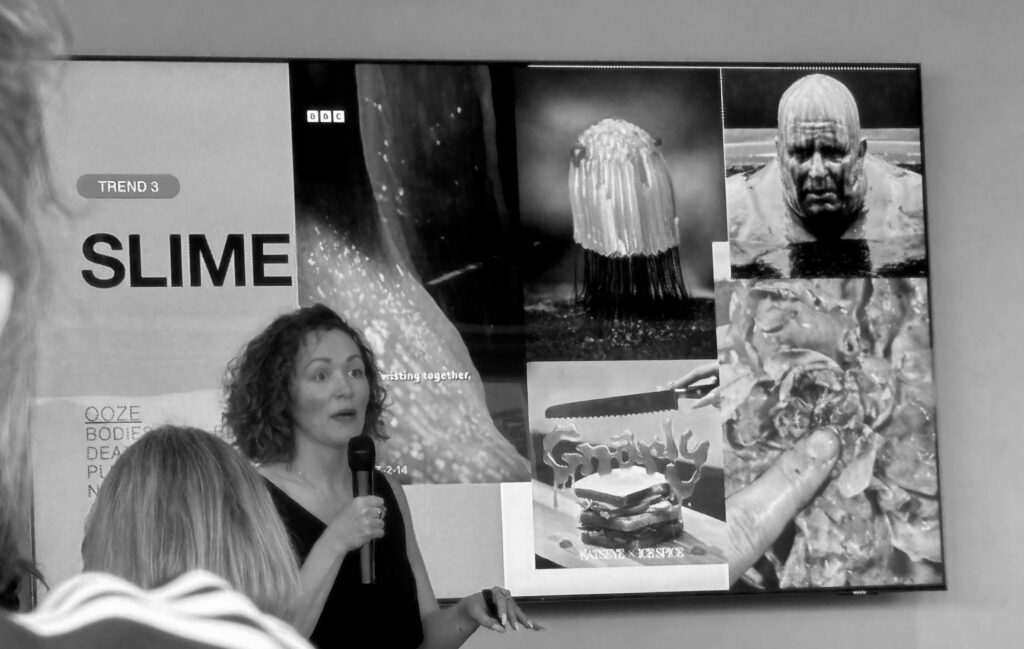
Dr Bridget Dalton presented the ooze, something she described as a move towards something more sensory, more real about the messiness of the moment and away from optimisation and aesthetic side of well-being and health.
Cultural institutions have been talking about being transparent for a while, but it’s perhaps those that do it in way that shows the messy underbelly of their collections. Or unresolved challenges into public conversations that will be more in step with where audiences are heading than those still reaching for the polished and definitive.
From Signal to Strategy
What struck me most was there are already patterns of this work too within cultural institutions. However, they rarely it makes its way out of late-night events programming or social media experiments. This suggests that the models and thinking are in place to build upon. However there aren’t the processes or systems to grow to influence more strategic investment that would ensure cultural institutions continue to adapt and stay relevant.
Putting it into practice?
If you’d like to see what how we use foresight to help organisations make choices about their future strategy, check out this case study of providing digital foresight for the National Trust‘s 10 year strategy.
Want a sounding board about the trends you’re seeing
Book an UnOffice Hour to talk it through.
Or sign up to our newsletter for more on what we’re learning and how others are putting these ideas into practice.